




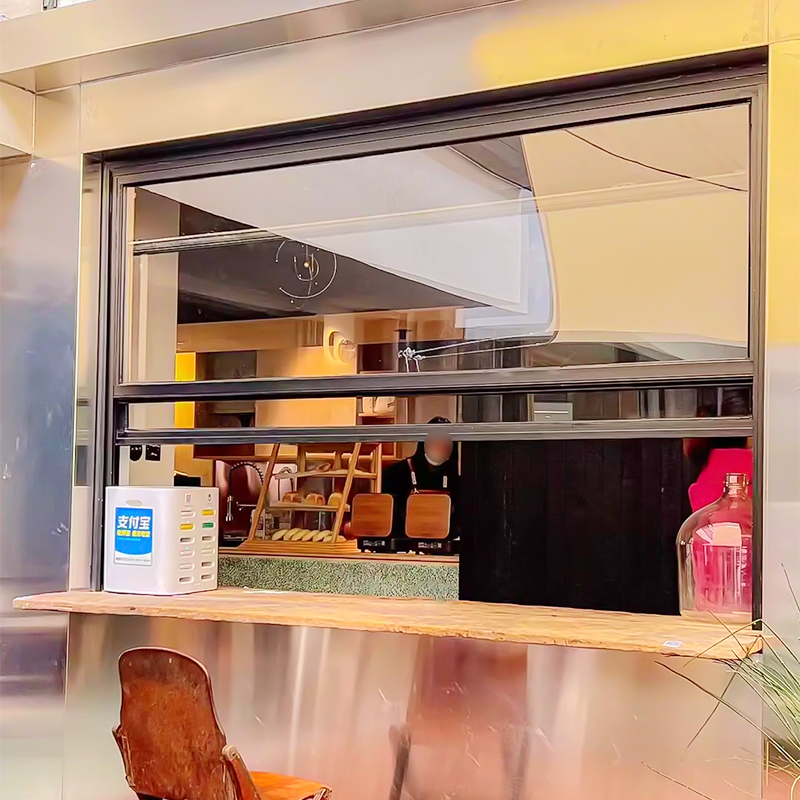


How does deformation of the window sash of a manual lifting window affect its lifting function?
Release Time : 2025-12-01
Deformation of the window sash in a manual lifting window can significantly impact its lifting function. This impact extends beyond operational smoothness and can potentially pose safety hazards. As a core component of the lifting system, the window sash's structural integrity directly determines the system's operational efficiency and stability. When the window sash deforms due to external impact, prolonged use, or material aging, friction during lifting increases significantly, leading to greater operational resistance and requiring the user to apply more force to complete the movement. Initially, this may manifest as slight jamming, but as the deformation worsens, the jamming can gradually evolve into complete blockage, and forced operation may even damage the lifting mechanism.
Window sash deformation can take many forms, commonly including localized dents, edge warping, or overall twisting. Localized dents are usually caused by external impacts, which disrupt the flatness of the contact surface between the window sash and the guide rail, causing irregular friction during lifting. Edge warping is often caused by material fatigue or improper installation; the warped edge interferes with the guide rail or sealing strip, hindering normal lifting. Overall twisting is more serious, possibly due to insufficient strength of the window sash frame or long-term uneven stress. This deformation completely alters the window sash's trajectory, preventing it from lifting along the intended track. Different types of deformation have varying degrees of impact on the lifting function, but all will shorten the lifespan of the lifter.
The fitting precision between the guide rail and the window sash is a key factor affecting the lifting function. The guide rail is designed to provide a stable movement path for the window sash; its surface smoothness and dimensional accuracy directly determine the lifting resistance. When the window sash deforms, gaps or misalignments appear on the originally tightly fitted contact surfaces, causing wobbling or deviation during lifting. This abnormal movement further exacerbates wear on the guide rail and window sash, creating a vicious cycle. For example, edge warping of the window sash may cause uneven lateral forces on the guide rail, leading to deformation over time and ultimately causing the entire lifting system to fail.
The function of the weatherstripping is not only dust and water protection, but its elastic properties also cushion the impact of window sash operation. When the window sash deforms, the compression of the weatherstripping changes, potentially leading to excessive localized compression or loss of contact. Excessive compression increases resistance during operation, while loss of contact reduces sealing performance, causing air and water leaks. Furthermore, aging weatherstripping exacerbates this effect; as it loses its elasticity, it cannot effectively compensate for gaps caused by window sash deformation, further worsening the operation.
The gears, chains, and linkages of the window regulator are designed with specific stress ranges in mind. When the window sash deforms, the resistance distribution during operation changes, potentially causing some components to experience stresses exceeding their design values. For example, gear meshing points may deviate from their normal positions due to window sash misalignment, causing increased localized wear; chains may stretch or break due to uneven stress; and linkages may deform due to prolonged exposure to abnormal torque. Damage to these components can not only cause abnormal noises or jamming but may also lead to complete malfunction of the window regulator.
The impact of window sash deformation on safety cannot be ignored. Manual lifting windows with anti-pinch function automatically stop or retract when abnormal resistance is detected. However, window sash deformation may cause a change in the resistance threshold, rendering the anti-pinch function ineffective. Furthermore, a deformed window sash may suddenly detach during lifting, causing injury to occupants. For example, warped window sash edges may jam the guide rail, causing the lift motor to run continuously while the window sash cannot move, ultimately leading to motor burnout or overheating of the wiring, posing a safety hazard.
To avoid the impact of window sash deformation on the lifting function, avoid forceful operation during daily use. Regularly check the fit between the window sash and the guide rail, and promptly clean foreign objects and dust from the guide rail. If slight deformation is found, initial repair can be achieved by adjusting the fixing screws or replacing the sealing strip; if the deformation is severe, the entire window sash or lift assembly needs to be replaced. Regular maintenance and timely repair are key measures to extend the service life of manual lifting windows and ensure their functional stability.